Triggers play a vital role in defining the starting point of your Tidio flow. In this article, we will explore the concept of triggers and all the available options, empowering you to create dynamic and effective flow experiences.
In this article, you'll learn:
Adding a trigger
The main idea behind building the flows is to create maps that show the chat what to do exactly and when. A trigger tells the flow when the workflow starts.
So, the first step in creating a flow is to choose the correct trigger that will tell your flow when to start.
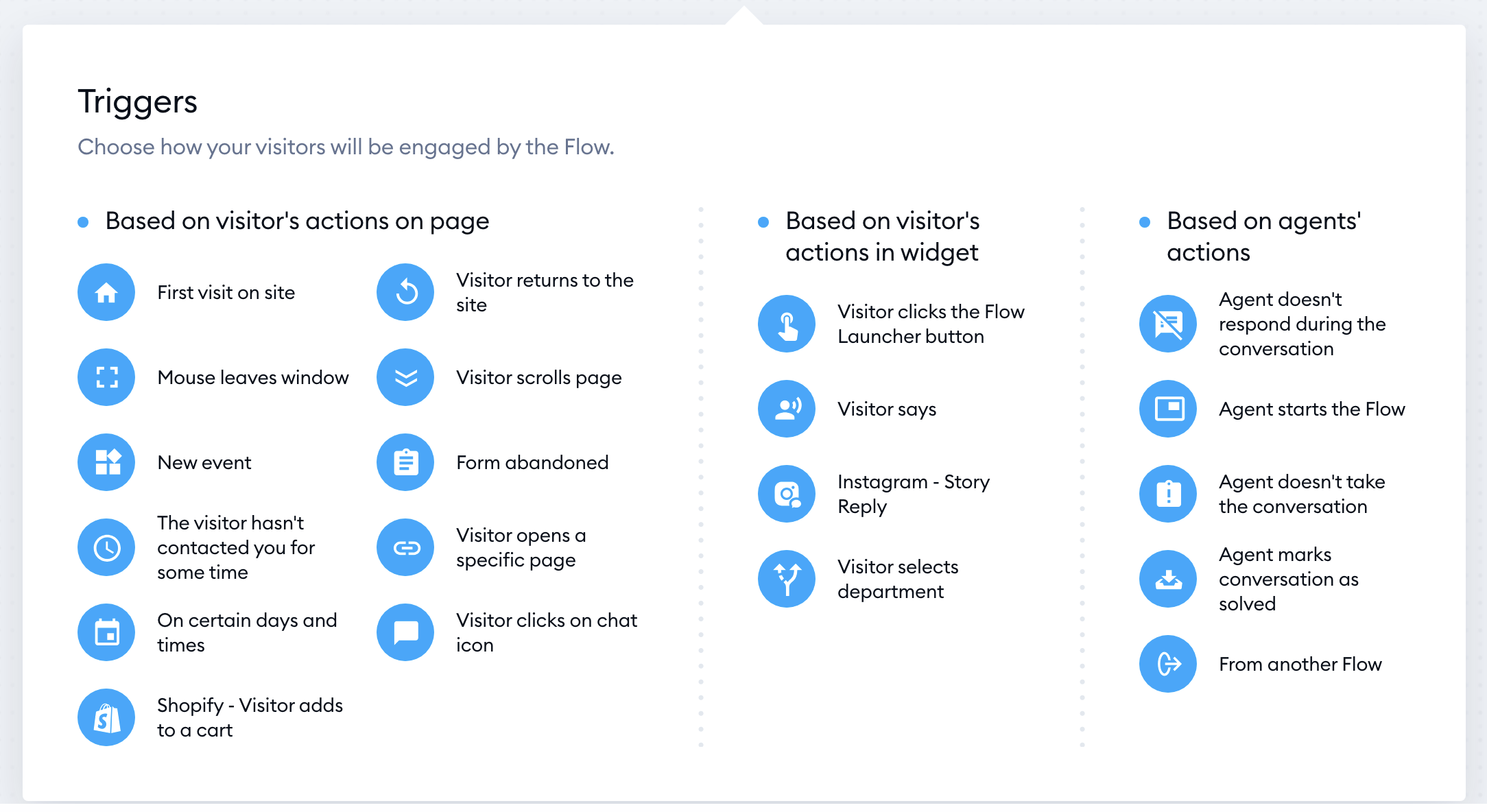
In the Triggers tab of the menu on the right, triggers are categorized into three main groups, each serving a unique purpose:
- Based on visitor's actions on page - by the action they made on your website (or your store).
- Based on visitor's actions in widget - by clicking or typing in the chat widget.
- Based on agents' actions - when an agent starts the flow, or doesn't react in time.
Once you have the starting point specified, you can add and connect the actions that should take place after the trigger has occurred. Since the grid shows the logical chain of events, the actions must be connected in chronological order. The line connecting them needs to be drawn from the action to the reaction that follows.
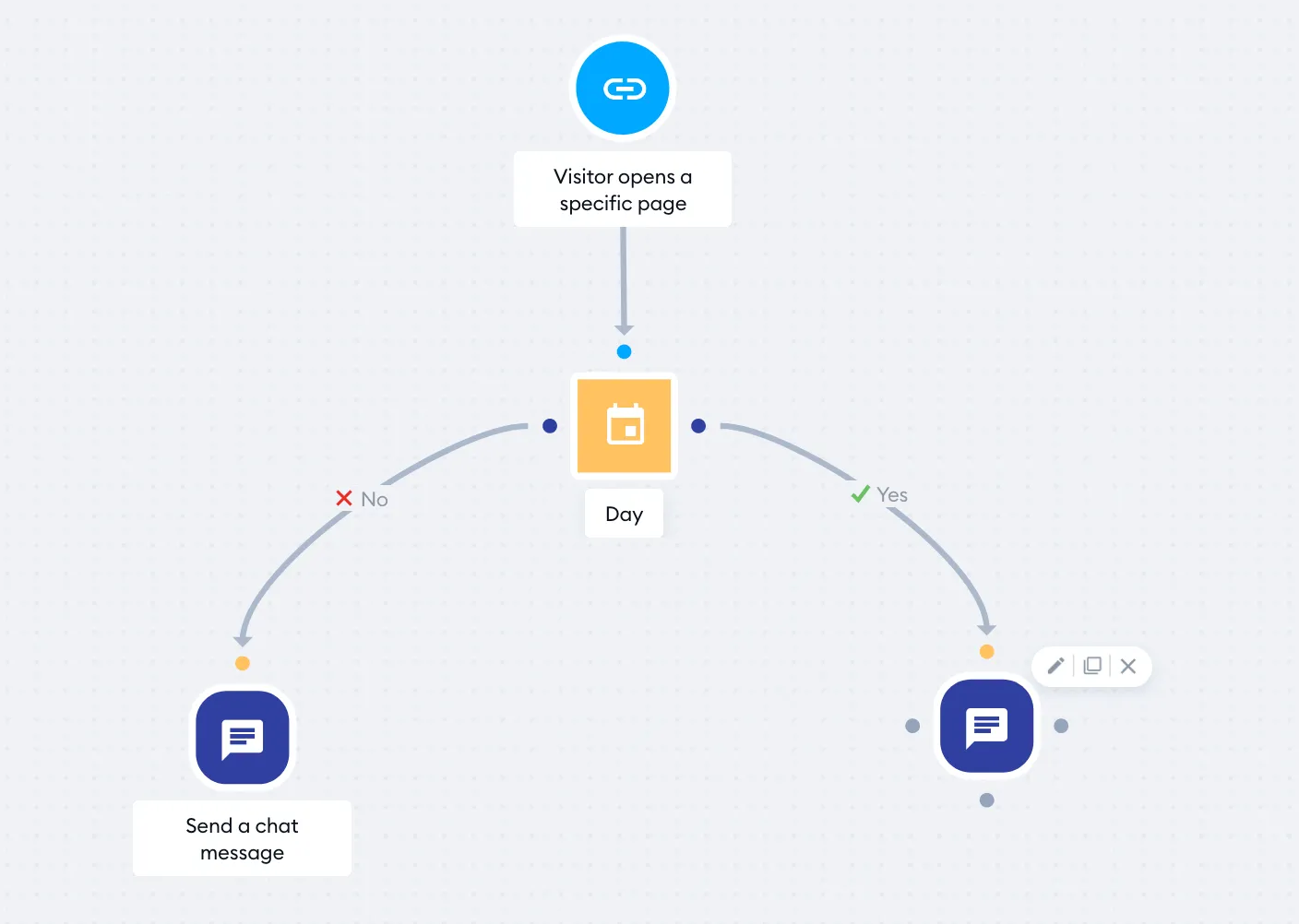
The basic scenarios usually consist of a trigger and the following actions, but you can also build more complex reactions using conditions . Conditions filter out the path for the actions, targeting things like the day, operating system, or even specific names. Most conditions branch out with a Yes and No path, allowing you to set a different action for each path. A few have paths of their own - for example, Chat status branches into Online and Offline.
Available triggers
Click on one of the links below to go to a specific trigger quickly:
- First visit on site
- Visitor returns to the site
- Visitor opens a specific page
- Visitor clicks on chat icon
- From another Flow
- Visitor scrolls page
- Mouse leaves window
- On certain days and times
- Shopify - Visitor adds to a cart
- Judge.me - Visitor clicked a rating
- Judge.me - Visitor posted a review
- New event
- The visitor hasn't contacted you for some time
- Form abandoned
- Visitor clicks the Flow Launcher button
- Visitor says
- Visitor selects department
- Instagram - Story Reply
- Agent doesn't take the conversation
- Agent doesn't respond during the conversation
- Agent starts the Flow
-
Agent marks conversation as solved
First visit on site
The flow starts when a new visitor lands on your website for the first time.
Visitor returns to the site
The flow starts when the visitor returns to your site (is not a new visitor).
Visitor opens a specific page
The flow starts when the visitor opens a page you specified inside the trigger.
Visitor clicks on chat icon
The flow starts when the visitor clicks on the Tidio chat icon visible on your website.
From another Flow
This is a dedicated trigger used in creating portals. A flow with this trigger will only be launched if another (source) flow targets it specifically, with its To another Flow action.
Visitor scrolls page
The flow will trigger when the visitor scrolls your website by a set percentage.
Mouse leaves window
The flow starts when the visitor's mouse pointer leaves your website window for 5 seconds.
On certain days and times
The flow starts only on the specified days and times of the day.
Shopify - Visitor adds to a cart
The flow will trigger when a visitor adds an item to their shopping cart. At this moment, it only works when the integration with Shopify is activated.
Judge.me - Visitor clicked a rating / Judge.me - Visitor posted a review
If your store uses Judge.me product reviews, these two triggers start the flow when a visitor selects a rating while writing a review, or after they submit their review. In both, you tick the ratings (1 to 5 stars) that should start the flow. You'll see them in the list once the Judge.me integration is installed in your project.
Screenshot coming soon
New event
The flow starts with a new event. The event can start directly from API, or you can activate automated events in your settings.
The visitor hasn't contacted you for some time
The flow starts when the visitor hasn't contacted you back for a specified time (counted in days). The flow will work only if the visitor has left you an email address.
Form abandoned
The flow starts when the visitor fills in the form and then leaves it.
Visitor clicks the Flow Launcher button
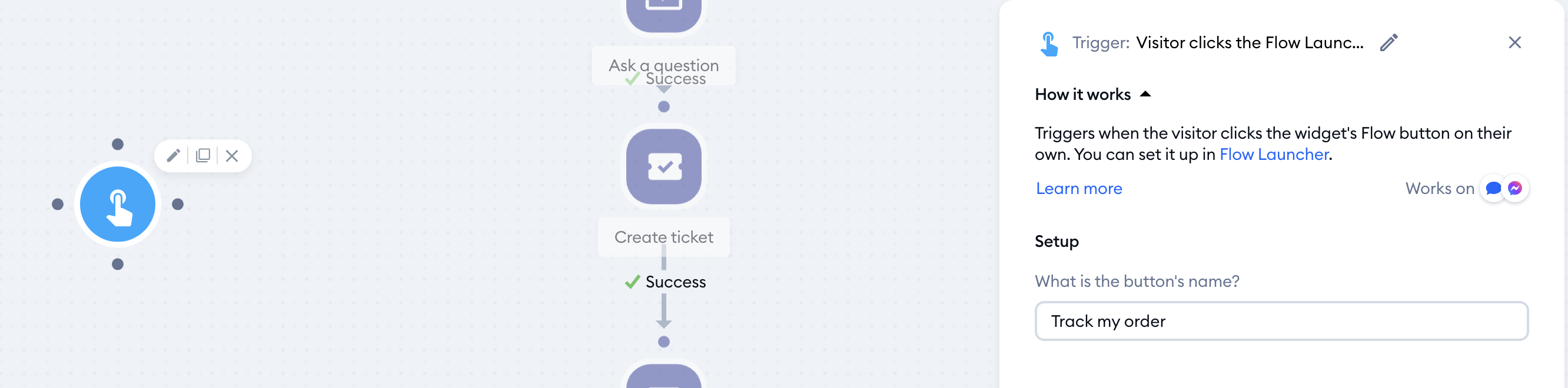
The flow starts when the visitor clicks one of the Flow buttons in your chat widget. Type in the button's name in the trigger, under What is the button's name?. You set up how the buttons are shown in the Flows launcher, at the bottom of the Flows menu. Learn more in The Flows launcher.
Visitor says
The flow starts when a visitor's message is similar to the phrases you defined, in the language you picked. This trigger isn't available on every plan - if it's not on yours, the trigger shows "This trigger isn't available on your plan." instead of its settings. See Visitor Says (flow trigger) for the details.
Visitor selects department
The flow will trigger when the visitor chooses a certain department. Please remember that this flow will work only when you have the departments feature (available on the Plus plan and above), with the Pre-chat survey turned on and Routing rules for your departments set up. The trigger's Quick tip shows where: Settings > Team > Departments and Live Chat > Appearance > Pre-chat Survey.
Instagram - Story Reply
The flow starts when a visitor replies to your Instagram story.
Agent doesn't respond during the conversation
The flow starts when an agent is already assigned to a conversation but hasn't responded for a specified amount of time - from 1 to 3,600 seconds or minutes. If conditions are met, the flow can trigger once per hour.
Agent starts the Flow
The flow starts when the agent triggers the flow during a chat conversation. The flow will take over the conversation.
Agent doesn't take the conversation
The flow starts when the agent hasn't opened a new incoming chat (it remains unassigned) within the time you set - from 1 to 3,600 seconds or minutes. If conditions are met, the flow can trigger once every 24h.
Agent marks conversation as solved
The flow starts when the agent clicks on the solved button in the chat conversation.
By understanding triggers in Tidio, you can create flows that respond to specific visitor actions, agent engagement, and flow button/typing interactions. Utilizing triggers effectively enables you to design flow experiences that enhance customer interactions, automate processes, and deliver personalized assistance. Take advantage of triggers to unlock the full potential of your flows.
